
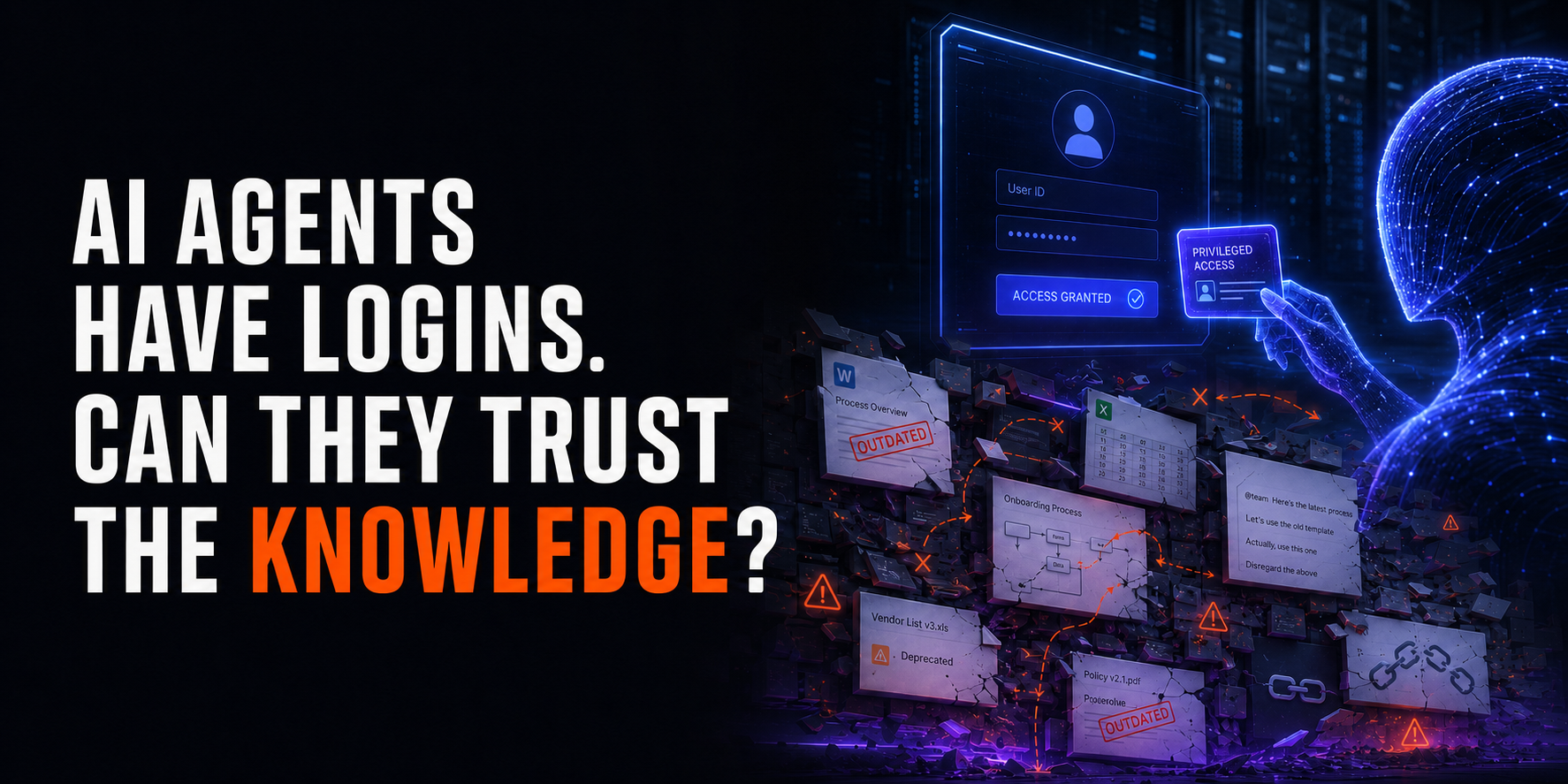
The real enterprise AI problem is not the model. It is the missing knowledge layer behind it.
AI agents are starting to move into real business workflows.
They are reviewing information, completing recurring tasks, supporting employees, drafting responses, checking records, and moving work from one system to another.
Some organizations are even treating agents like digital employees.
They give them names.
They give them access.
They give them responsibilities.
And, in some cases, they give them login credentials.
That sounds like progress.
It also sounds like a governance disaster waiting to happen.
Because many of these organizations are assigning work to AI agents before fixing the knowledge those agents depend on.
The problem is not that the agent lacks intelligence.
The problem is that the company has never made its own knowledge clear, structured, governed, or trustworthy.
An agent cannot use what the organization has never defined
Every company has two versions of how work gets done.
The first version lives in official documentation.
The second version lives in Slack messages, employee memory, spreadsheets, old process documents, shared drives, and the heads of the people who have been there the longest.
Guess which version employees actually use.
This is already a problem for humans.
For AI agents, it becomes much worse.
An experienced employee can usually tell when a process document is outdated. They know who to ask, which rule gets ignored, and when an exception applies.
An AI agent does not know any of that unless the company explicitly captures it.
It does not understand that:
- the process document was last updated three years ago
- the policy changed after a product release
- the spreadsheet contains the real approval rules
- the person listed as the owner left the company
- the instructions only apply to one customer segment
- the “standard” workflow has six undocumented exceptions
The agent simply uses the information it can access.
Then it produces an answer, takes an action, or sends a response with complete confidence.
That is not automation.
That is automated guesswork.
Access is not the same as readiness
Many organizations think they are ready for AI because they connected their tools.
They connected the CRM.
They connected the help centre.
They connected the shared drive.
They connected the project management system.
Then they assumed the agent would somehow make sense of everything.
But connecting fragmented information does not create reliable knowledge.
It creates faster access to fragmentation.
This is where many enterprise AI projects go wrong.
Companies focus on the model, the interface, and the integration while ignoring the knowledge infrastructure underneath.
They ask:
Which AI platform should we buy?
They should also ask:
What information will the agent use, and can we trust it?
That question is less exciting.
It is also far more important.
Before you assign work to an AI agent, answer five questions
1. What sources can the agent use?
Not every document should become an approved source.
Some content is outdated. Some is duplicated. Some was written for a different audience. Some reflects personal opinion rather than company policy.
Organizations need a defined source-of-truth model.
The agent should know which systems are authoritative and which are merely reference material.
2. Who owns the knowledge?
Every critical piece of information needs an owner.
That person or function must be responsible for reviewing changes, resolving conflicts, and confirming accuracy.
Without ownership, outdated knowledge stays in circulation forever.
Humans work around it.
Agents scale it.
3. What decisions can the agent make?
An agent should not have unlimited freedom simply because it can perform a task.
Organizations need clear decision boundaries.
What can the agent complete independently?
What requires human review?
What should always trigger escalation?
What happens when the agent finds conflicting instructions?
These are operating rules, not technical settings.
4. How are exceptions handled?
Business processes are full of exceptions.
A customer has a special contract.
A system is temporarily unavailable.
A regulated request needs additional review.
A long-standing client follows a different workflow.
Most process documents describe the happy path.
Agents need the exception paths too.
Otherwise, they will perform well during routine work and fail precisely when judgement matters most.
5. Can the organization audit what happened?
When an agent takes action, the company needs a record.
Which source did it use?
Which rule did it apply?
What information influenced the outcome?
Who approved the action?
What happened when the agent was uncertain?
Without traceability, organizations cannot investigate mistakes, improve performance, or prove compliance.
The market is shifting from AI tools to AI operating systems
For the last few years, companies competed to adopt AI tools.
Now the harder work begins.
They need to redesign how information, decisions, and accountability flow through the business.
That means the next phase of enterprise AI will depend less on prompt tricks and more on:
- trusted knowledge sources
- structured processes
- defined ownership
- clear decision boundaries
- approval workflows
- exception handling
- audit trails
- continuous knowledge maintenance
In other words, AI adoption is becoming a knowledge and operations problem.
This is why documentation is no longer a support function sitting at the end of the process.
It is part of the infrastructure.
The procedures, policies, product information, support content, workflows, and decision rules all shape what an AI agent can understand and do.
Bad documentation no longer creates only frustrated employees or confused customers.
It creates unreliable automated action.
That raises the stakes considerably.
The real competitive advantage is not the agent
Most companies will have access to similar models.
They will use many of the same platforms.
They will buy tools from the same vendors.
The real difference will come from the quality of the knowledge each company connects to those systems.
An organization with clear, governed, current information will get more reliable outputs.
An organization with messy, contradictory, ownerless information will automate confusion.
The model may be powerful.
But it cannot repair an organization that has never made its knowledge usable.
Before you give an AI agent a login, give it something better:
A trusted knowledge system.
Because the future of enterprise AI will not be decided by who deploys the most agents.
It will be decided by who gives those agents the clearest, most reliable understanding of how the business actually works.
I help SaaS teams turn scattered documentation into structured, AI-ready systems that reduce repeated questions, support better decisions, and make knowledge easier to trust.
The AI-Ready PM
Where documentation becomes systems, and systems become AI-ready.