
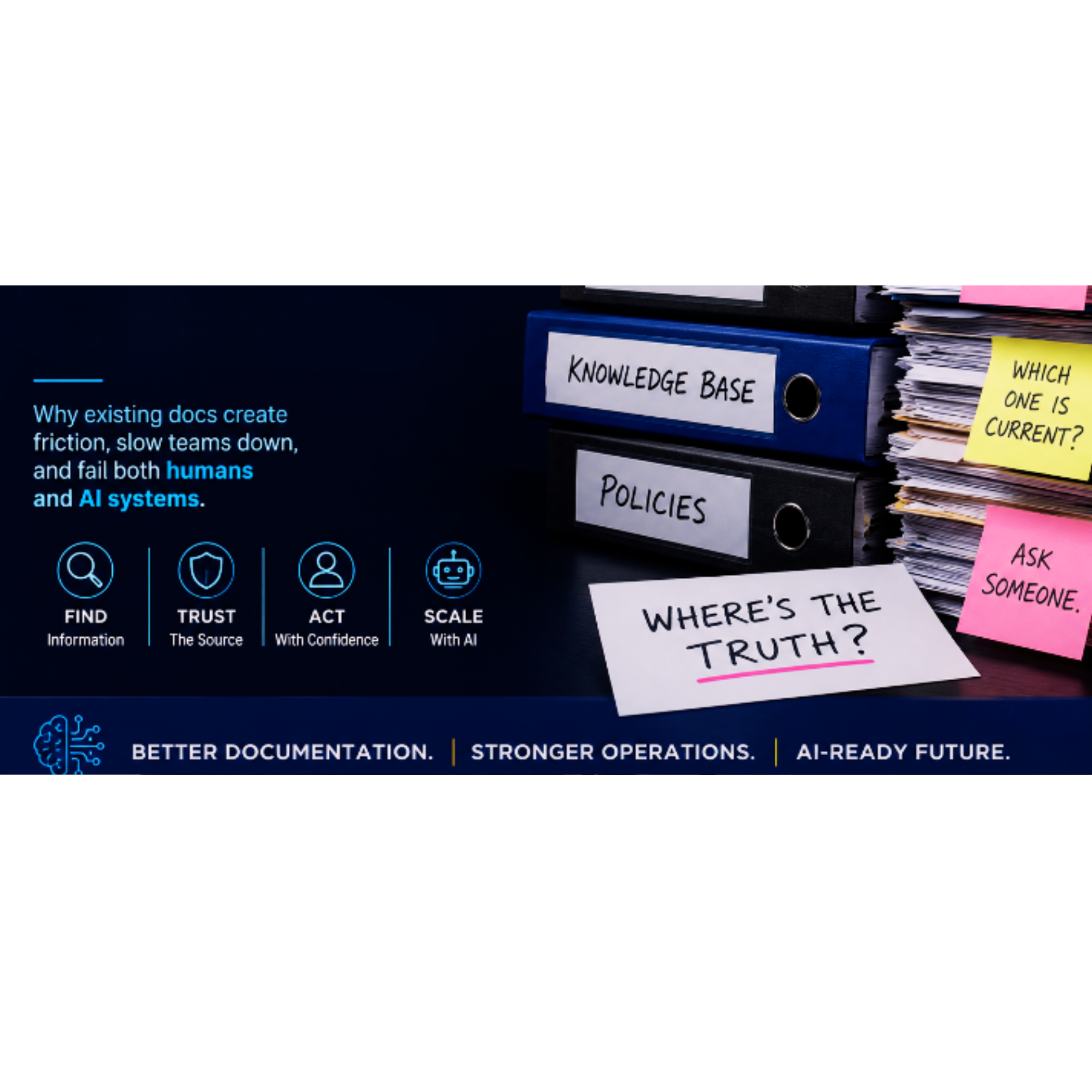
Are people using your documentation, or are you storing documentation?
Most teams say they have documentation.
And technically, they do.
There’s a help center.
There are SOPs.
There’s a Notion workspace with enough pages to emotionally intimidate new hires.
There are Google Docs named things like: Final_v2_UPDATED_REALFINAL
So yes.
Documentation exists.
But existence is not the same as usability.
Because the real question is not: “Do we have documentation?”
The real question is: “Can people actually use it without asking someone for help?”
That’s where most systems quietly break.
A support rep searches for an answer and still pings Product to confirm it.
A new hire reads the onboarding docs and still needs three meetings to understand the workflow.
A process changes, but the documentation doesn’t.
Six months later, half the company is following version A, the other half is following version B, and one brave soul is following a Slack message from 2024 like it’s sacred scripture.
Nobody calls this a documentation problem.
They call it “how things work around here.”
That’s the expensive part.
And now AI is entering the picture.
Which means messy documentation no longer creates only human friction. It creates machine friction, too.
I was reading a recent article from The Content Wrangler on AI and documentation quality, and it reinforces something many organizations are about to learn the hard way:
AI doesn’t fix messy documentation. It amplifies it.
If your documentation is outdated, duplicated, inconsistent, or unclear… your AI systems inherit the same problems.
Just faster.
And with more confidence.
I touched on this in my previous newsletter:
Your documentation hasn’t failed yet. That’s the problem
That issue focused on hidden operational risk.
This issue is about what happens next: The slow breakdown of trust.
Because when teams stop trusting documentation, they stop using it.
And when that happens, people become the system.
That’s when:
- onboarding slows
- support escalations increase
- repeated questions multiply
- key employees become bottlenecks
- AI retrieval becomes unreliable
The documentation may still exist.
But operationally?
It’s already failing.
Documentation as plumbing
Good documentation is a lot like plumbing.
Nobody celebrates plumbing when it works.
No one sends a company-wide Slack message saying:
“Shoutout to the pipes today. Outstanding water delivery performance.”
But when plumbing fails, everybody notices immediately.
Documentation works the same way.
When it’s functioning properly:
- people find answers quickly
- onboarding moves faster
- support responds with confidence
- teams make decisions without rehashing the same conversations
- work keeps moving
When it’s broken:
- questions pile up
- meetings multiply
- knowledge gets trapped in people’s heads
- everyone starts improvising
And improvisation is not a scalable operating model.
Especially for AI.
The uncomfortable question
Here’s the question I wish more teams asked earlier:
If your best operator disappeared tomorrow, would your documentation hold, or collapse?
That question reveals almost everything. Strong documentation is not about storing information.
It’s about preserving operational clarity.
Can someone:
- find the answer?
- trust the answer?
- act on the answer?
- explain the answer?
Without chasing down a specific human?
That’s the real test.
The hidden cost nobody tracks
Most documentation problems never appear on a financial report.
Nobody writes: “Lost 11 hours this week to unclear processes.”
But the cost shows up everywhere else.
In repeated onboarding explanations.
In Slack interruptions.
In support escalations.
In duplicated work.
In delayed decisions.
In teams constantly asking:
“Wait… which version are we using?”
The friction compounds quietly.
Which is exactly why so many organizations underestimate it.
What a working system actually looks like
A healthy documentation system doesn’t mean documenting every microscopic detail forever until your team starts hallucinating folders.
It means people can answer four basic questions:
- What is true now?
- Where does this information live?
- Who owns it?
- Can someone act on it without guessing?
That’s it.
That’s the foundation.
Because documentation is not just content. It’s operational infrastructure.
And increasingly, it’s the knowledge layer your AI systems depend on.
Wrapping It Up
If your team relies on memory over documentation, you don’t have a system.
Message me “Audit.”
Ready to Scale Your Product Smarter?
My solutions collapse time, reduce chaos, and empower your teams with AI-powered clarity and streamlined workflows.
Get your free AI-Readiness Checklist.
Want personalized guidance?
These options are available:
- Done-for-You (DFY),
- Done-with-You (DWY)
- Do-it-Yourself (DIY)
♻️ Repost to help someone structure their docs for 2026.
🔔 Follow me, Veronica, for Documentation & AI implementation that actually works.
➡️ Remember: companies replacing humans with AI need humans who understand AI.
Warmly,
Veronica Phillip
Founder, ProTech Write & Edit Inc.
Author of The AI-Ready PM — calm guidance on documentation, systems, and AI readiness for SaaS companies.